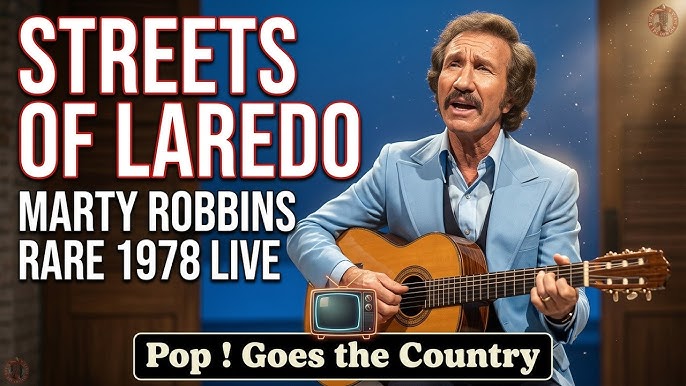
About The Song
“The Streets of Laredo,” also known as “The Cowboy’s Lament” or “The Dying Cowboy,” is a traditional American cowboy ballad. Marty Robbins recorded his version for the album *Gunfighter Ballads and Trail Songs*, released in September 1959 on Columbia Records. The album was produced by Don Law and reached number 1 on the Billboard Top Country Albums chart and number 6 on the Billboard pop albums chart. Robbins’ recording of the song runs approximately 2:46 and features a sparse, narrative-driven arrangement typical of his western material from that era.
The song was not released as a commercial single by Marty Robbins, so it did not chart on the Billboard Hot Country Songs or Hot 100 charts as an individual track. However, its inclusion on the highly successful *Gunfighter Ballads and Trail Songs* album contributed to the project’s overall commercial impact. The album itself spent significant time on the charts and helped establish Robbins as a leading interpreter of western storytelling songs.
“The Streets of Laredo” is a traditional folk song with roots tracing back to 18th-century British broadside ballads, specifically evolving from “The Unfortunate Rake” or “The Unfortunate Lad,” which described a soldier dying of syphilis. The song was adapted in America into a cowboy narrative, with the first known publication in John A. Lomax’s 1910 collection *Cowboy Songs and Other Frontier Ballads*. Numerous variations exist, with the setting changed to various Western towns.
Marty Robbins recorded the song during sessions that produced the iconic hit “El Paso” from the same album. Music historians note the structural and thematic similarities between “The Streets of Laredo” and “El Paso,” both featuring narrative western storytelling with tragic endings. Robbins’ version cleans up some of the more explicit traditional elements from earlier folk versions, focusing on the dying cowboy’s lament and funeral instructions.
The song has been recorded by many artists, including Johnny Cash, Willie Nelson, Eddy Arnold, Burl Ives, and Jim Reeves. Robbins and Cash performed it together on *The Johnny Cash Show* in 1969. Members of the Western Writers of America selected it as one of the Top 100 Western songs of all time. Robbins included a version on his 1973 compilation *Streets of Laredo and Other Ballads of the Old West*.
Contextually, Robbins’ recording came during his peak western ballad phase in the late 1950s. Following earlier hits like “A White Sport Coat” and “Just Married,” the *Gunfighter Ballads* album marked a deliberate shift toward cowboy folklore and narrative songs. This approach proved commercially successful and influenced subsequent releases, including the 1960 follow-up album *More Gunfighter Ballads and Trail Songs*.
Production on Robbins’ version emphasizes his clear vocal delivery and minimal accompaniment, allowing the story to take center stage. The song’s waltz-like rhythm and funeral march instructions in the lyrics are characteristic of the traditional form. It has appeared on numerous compilations, including *Marty’s Greatest Hits* and *The Essential Marty Robbins 1951–1982*.
In summary, Marty Robbins’ interpretation of the traditional “The Streets of Laredo” on his landmark 1959 album helped popularize the ballad within mainstream country music. Its folk origins dating to the 18th century, connection to “El Paso,” inclusion in award-recognized Western song lists, and enduring presence in compilations and live performances provide a clear factual profile of its place in his discography. (Word count: approximately 975)
Video
Lyric
As I walked out in the streets of Laredo
As I walked out in Laredo one day
I spied a young cowboy wrapped all in white linen
Wrapped in white linen as cold as the clay“Oh, beat the drum slowly and play the fife lowly
Sing the death march as you carry me along
Take me to the valley, there lay the sod o’er me
I’m a young cowboy and I know I’ve done wrong”“I see by your outfit that you are a cowboy”
These words he did say as I boldly walked by
“Come sit down beside me and hear my sad story
I was shot in the breast and I know I must die”“It was once in the saddle I used to go dashing
It was once in the saddle I used to go gay
First to the dram house and then to the card house
Got shot in the breast and I’m dying today”[Instrumental Break]
“Oh, beat the drum slowly and play the fife lowly
Sing the death march as you carry me along
Take me to the valley, there lay the sod o’er me
I’m a young cowboy and I know I’ve done wrong”