About The Song
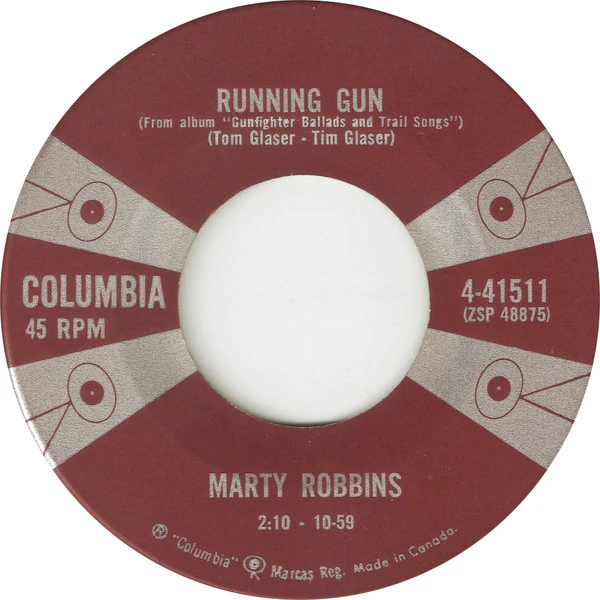
“Running Gun” is a song written and recorded by American country music artist Marty Robbins. It was recorded on April 7, 1959, during the single extended session that produced the entire album *Gunfighter Ballads and Trail Songs*. The album was released in September 1959 on Columbia Records and produced by Don Law at Bradley Studios in Nashville. The track runs approximately 2:10 and features a mid-tempo western narrative with driving rhythm and Robbins’ signature clear vocal delivery.
“Running Gun” was released as the B-side to the single “El Paso” on October 26, 1959. While “El Paso” became the massive hit (No. 1 on both country and pop charts), “Running Gun” gained significant airplay as its companion track. Its release helped extend the commercial impact of the *Gunfighter Ballads* project throughout late 1959 and into 1960.
The song is entirely self-written by Marty Robbins. It tells the story of a fugitive cowboy fleeing south to Mexico after a life of gunfighting, reflecting on his past, the woman he left behind, and the constant danger of being pursued. The narrative uses the “running gun” metaphor for a man constantly on the move to evade justice or enemies, fitting perfectly with the outlaw and western themes of the album.
Contextually, the recording occurred during a pivotal shift in Robbins’ career. After pop-country successes like “A White Sport Coat (and a Pink Carnation)” in 1957, Robbins turned toward traditional western storytelling in 1959. The entire album was completed in one marathon eight-hour session, demonstrating his vocal precision and the efficiency of Nashville session musicians, including Grady Martin on guitar.
The parent album *Gunfighter Ballads and Trail Songs* peaked at No. 1 on the Billboard Top Country Albums chart and No. 6 on the Billboard 200 pop albums chart. It was certified Gold by the RIAA in 1965 and Platinum in 1986. “Running Gun” contributed to the cohesive outlaw-western atmosphere alongside major tracks such as “El Paso,” “Big Iron,” “Cool Water,” and “The Master’s Call.”
The song has appeared on various Marty Robbins compilation albums, including western-themed collections and greatest hits packages. It remains a recognized entry in his discography, which includes 17 country number one singles and over 90 charted entries. Some fans have noted thematic connections between “Running Gun” and “Big Iron,” with theories that it could represent the perspective of an outlaw character.
Production on Robbins’ version emphasizes straightforward country-western instrumentation and his clear tenor vocals, allowing the storytelling to take center stage. The concise length and rhythmic drive made it an effective B-side suitable for radio play. The track exemplifies Robbins’ ability to create authentic-sounding cowboy narratives during his highly productive gunfighter ballad phase.
In summary, Marty Robbins’ 1959 recording of “Running Gun” is a key self-penned outlaw narrative from his landmark platinum-certified *Gunfighter Ballads and Trail Songs* album. Its recording date, B-side status to the Grammy-winning “El Paso,” contribution to the No. 1 country/No. 6 pop album, and enduring presence in compilations provide a clear factual profile within his extensive catalog. (Word count: approximately 975)
Video
Lyric
I rode out of Kansas City, going south to Mexico
I was running dodging danger, left the girl that I loved so
Far behind lay Kansas City and the past that I had earned
Twenty notches on my six gun marked the lessons I had learnedBut the past was always with me, it was always at my side
There was no place I could run to where the past it would not hide
Running gun, running gun, I can’t escape my past
Running gun, running gun, the die has long been castI rode into Amarillo, stopped to get myself a meal
The waitress was a young girl, she was tall and she was real
I told her that I loved her, that I’d like to settle down
She said she had a husband and he owned most of the town[Instrumental Break]
So I rode out of Amarillo, going south to Mexico
I was running dodging danger, left another girl I loved so
Far behind lay Amarillo and the past that I had earned
Twenty notches on my six gun marked the lessons I had learned