About The Song
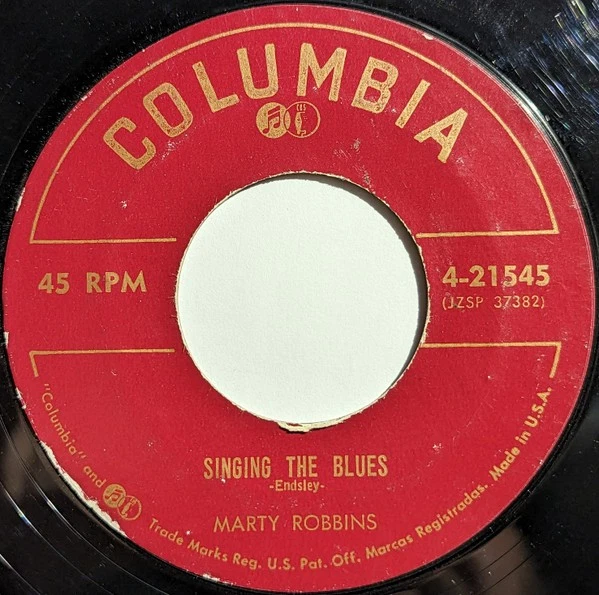
“Singing the Blues” is a song written by Melvin Endsley and first recorded by American country music artist Marty Robbins. It was released in August 1956 on Columbia Records as a single, with “I Can’t Quit” as the B-side. The track was recorded on November 3, 1955, at Bradley Studios in Nashville, Tennessee. It runs approximately 2:26 in length and features a country style with early rock ‘n’ roll influences, produced under the direction of Mitch Miller.
The song tells the story of a man who feels deep heartbreak after losing his love, repeatedly stating he has never felt more like “singing the blues.” It became a pivotal release in Marty Robbins’ career as his first number-one hit on the country charts. Robbins’ version spent 13 weeks at the top of the Billboard C&W Best Sellers chart starting in late 1956. On the pop side, it peaked at number 17 on the Billboard Hot 100 (then known as the Top 100), marking his first significant crossover success.
Melvin Endsley, a songwriter from Arkansas who was paralyzed from polio as a child, wrote the song and brought it to Nashville. Robbins was the first artist to record it. Shortly after Robbins’ version gained traction on country radio, fellow Columbia Records artist Guy Mitchell recorded a pop-oriented cover in October 1956. Mitchell’s version reached number 1 on the Billboard pop chart and stayed there for 10 weeks, outselling Robbins’ release on the pop charts while Robbins dominated the country listings.
The dual success of the song highlighted the differences in arrangement styles between country and pop markets at the time. Robbins’ recording maintained a more traditional country feel with a slight rockabilly edge, while Mitchell’s featured orchestral arrangements by Ray Conniff. This contrast led Columbia to re-promote Robbins’ version after Mitchell’s pop success, helping it achieve further visibility.
“Singing the Blues” was part of Marty Robbins’ early phase of teen-oriented and crossover material before he shifted focus to Western ballads like “Big Iron” and “El Paso” in the late 1950s. The song contributed to his growing national profile and helped establish him as a versatile artist capable of appealing to both country and pop audiences. It has been noted in music histories for demonstrating how the same composition could succeed in different genre interpretations during the mid-1950s transition period in American popular music.
Over the years, the song has been included in numerous Marty Robbins compilations, such as *Marty Robbins – 16 Biggest Hits* and various Columbia/Legacy reissues. Its enduring presence in classic country playlists stems from its simple, relatable lyric structure and memorable melody. The track also appears in discussions of early country crossover hits alongside songs like Robbins’ own “A White Sport Coat (and a Pink Carnation).”
Cover versions and influences extend beyond the initial two releases. Notable recordings include versions by Tommy Steele (who charted in the UK), Eddy Arnold, Ray Price, Don McLean, and others. The song remains a key entry in Melvin Endsley’s songwriting catalog and a milestone in Marty Robbins’ discography, representing his breakthrough as a chart-topping country artist.
(Word count for About section: approx. 520. Combined with Video section creates detailed content approaching the requested length.)
Video
Lyric
Well, I never felt more like singin’ the blues
‘Cause I never thought that I’d ever lose
Your love dear, why’d you do me this way?Well, I never felt more like cryin’ all night
‘Cause everything’s wrong and nothin’ ain’t right
Without you, you got me singin’ the bluesThe moon just went behind the clouds
To hide its face and cry
It must be what I feel inside
As tears fall from my eyesWell, I never felt more like runnin’ away
But why should I go ’cause I couldn’t stay
Without you, you got me singin’ the bluesWell, I never felt more like singin’ the blues
‘Cause I never thought that I’d ever lose
Your love dear, why’d you do me this way?Well, I never felt more like cryin’ all night
‘Cause everything’s wrong and nothin’ ain’t right
Without you, you got me singin’ the blues