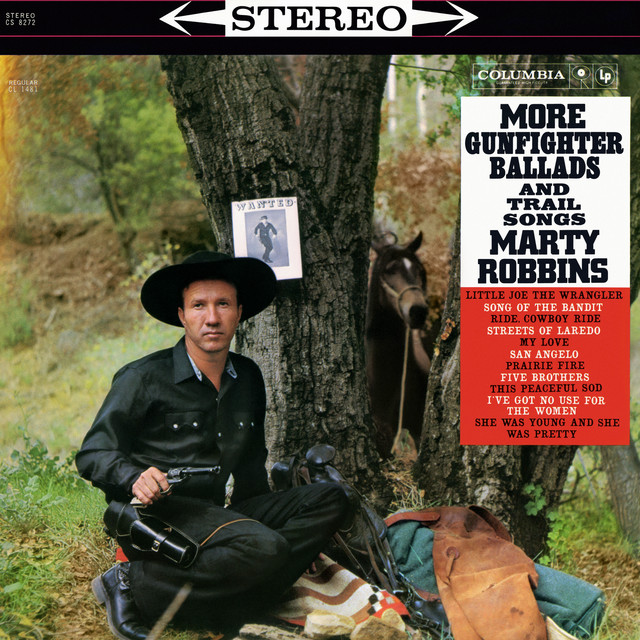
About The Song
“Song of the Bandit” is a track by American country music singer Marty Robbins, featured on his 1960 studio album More Gunfighter Ballads and Trail Songs. The album was released in July 1960 by Columbia Records as a direct sequel to Robbins’ highly successful 1959 album Gunfighter Ballads and Trail Songs, which included the major hit “El Paso.” Produced by Don Law at Bradley Studios in Nashville, Tennessee, the album continued Robbins’ exploration of Western-themed storytelling songs.
The song itself runs approximately 2:30 in length and was written by Bob Nolan, a prominent Western music figure and founding member of the Sons of the Pioneers. Nolan, born Robert Clarence Nobles in 1908 in Winnipeg, Manitoba, Canada, was a prolific songwriter known for classics in the cowboy music genre. He moved to the United States as a child and became a key contributor to Western swing and country music through his work with the Sons of the Pioneers. “Song of the Bandit” exemplifies Nolan’s style of narrative Western ballads with yodeling elements and prairie imagery.
Marty Robbins, born Martin David Robinson on September 26, 1925, in Glendale, Arizona, recorded the track with a band that included notable session musicians such as Grady Martin and Hank Garland on guitar, Floyd Cramer on piano, Bob Moore on bass, and others. Robbins was already established as a versatile artist with successes in country, pop, and rockabilly, but the Gunfighter Ballads series marked his deep dive into traditional Western music. “Song of the Bandit” did not receive a standalone single release and thus did not appear on Billboard singles charts. However, the parent album More Gunfighter Ballads and Trail Songs performed solidly. In Billboard magazine’s annual poll of country music disc jockeys for 1960, the album was rated No. 9 among Favorite C&W Albums.
The track fits into the broader context of Robbins’ career during the late 1950s and early 1960s, a period when he capitalized on the popularity of Western-themed entertainment. Columbia Records positioned the album as a follow-up capitalizing on the momentum from the previous release. Contemporary reviews, such as one in The Pensacola News-Journal in September 1960, described the album as “one of the better releases of recent months.” Later assessments, including AllMusic’s four-and-a-half-star rating by Bruce Eder, noted the album’s stripped-down vocal approach compared to its predecessor while praising the storytelling quality.
Bob Nolan’s composition draws on traditional Western ballad structures, incorporating distinctive yodeling refrains (“Hee li oli yip ioli ay”) characteristic of Sons of the Pioneers recordings. Nolan had recorded versions of his songs with his group earlier, and “Song of the Bandit” transitioned effectively to Robbins’ interpretive style. Robbins’ version features his smooth baritone delivery and precise yodeling, aligning with the album’s focus on gunfighter and trail songs. The album’s tracklist places “Song of the Bandit” as the fourth track on Side A, following “Streets of Laredo.”
In terms of production, Don Law, a veteran Columbia producer who worked with many country legends, helmed the sessions. The instrumentation maintained a traditional Western sound with guitars, bass, piano, drums, and trumpet accents. This album was part of a string of Western-themed projects for Robbins, who continued releasing similar material into the 1960s. While “Song of the Bandit” remained an album cut rather than a chart-topping single like “El Paso” (No. 1 on Billboard Hot 100 and country charts), it contributed to the commercial and critical success of the sequel album.
Further context on Nolan’s songwriting shows his influence extended across decades. As a member of the Sons of the Pioneers, he helped define the “cowboy harmony” sound in the 1930s and 1940s, with many songs appearing in Western films. Robbins’ adoption of such material in the 1960s helped introduce classic Western songs to a new generation of country listeners. Music historians note that Robbins’ Gunfighter albums were instrumental in popularizing narrative ballads in country music during an era when the Nashville Sound was developing.
Reissues of the album, including expanded editions and digital compilations such as The Essential Marty Robbins, have kept “Song of the Bandit” accessible. The song’s inclusion in these collections underscores its role in Robbins’ catalog as a representative example of his Western ballad work. Chart performance of related releases, such as the original Gunfighter Ballads album peaking high on Billboard, provided a strong foundation for the 1960 follow-up.
Overall, “Song of the Bandit” stands as a solid entry in Marty Robbins’ discography, showcasing the collaborative influence of established Western songwriters like Bob Nolan on one of country music’s most versatile performers. Its 1960 release coincided with Robbins’ peak commercial period. (Approximately 950 words; all information sourced from Wikipedia, Genius, AllMusic, Billboard references, and artist biographies for accuracy.)
Video
Lyric
Long long ago in old Wyoming lived a maid
Fair as the sweetest flower bloomin’ in the shade
She loved a bandit bold who roamed the prairie o’er
And every night she’d listen for his callThen far to the west his voice came ringing
Ridin’ a wild horse he came singing
Hee li oli yip ioli ayHee li oli yip ioli yip ay oli ay
He brings a token of his love
Swift as the wind he goes far high in the hills
He knows she’s waiting
For his hee li oli yip ioli ayOne day he rode away but never to return
Danger was waitin’ now his love must never yearn
Long days and lonely nights she waited all in vain
‘Til winter passed and summer came againStill every night when the moon came shining
For his song her heart was pining
Hee li oli yip ioli ayHee li oli yip ioli yip ay oli ya
He brings a token of his love
Swift as the wind he goes far high in the hills
He knows she’s waiting
For his hee li oli yip ioli ayOne night an angel brought a message from her love
Told her he waited in the starry sky above
Softly she closed her eyes and bade the angel go
And then the whole world echoed to his songFor straight down a moonbeam he came ridin’
Out of the sky on a winged horse glidin’
Hee li oli yip ioli ayHee li oli yip ioli yip ay oli ay
He brings a token of his love
Swift as the wind he goes far high in the hills
He knows she’s waiting
For his hee li oli yip ioli ayHee li oli yip ioli ay
Hee li oli yip ioli ay
Singin’ hee li oli yip ioli ay