About The Song
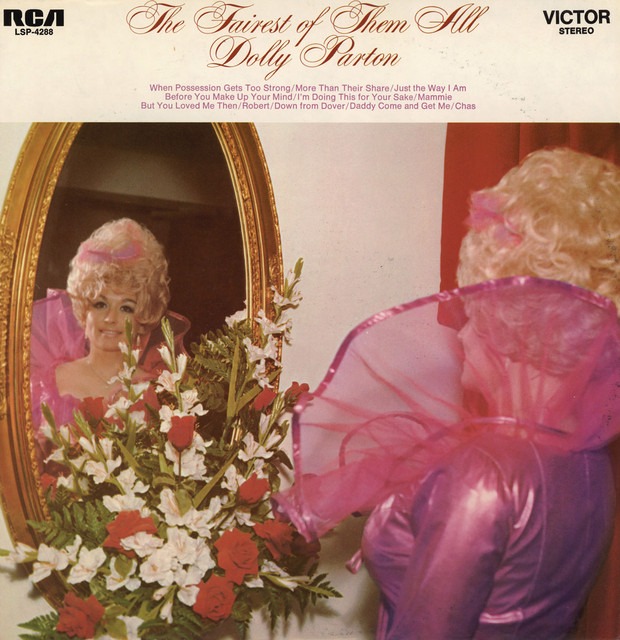
“Down from Dover” is a country song written and recorded by Dolly Parton. It first appeared on her fifth solo studio album, The Fairest of Them All, which was released on February 2, 1970, by RCA Victor. The album was produced by Bob Ferguson. Recording sessions for the project took place at RCA Studio B in Nashville between September 10, 1968, and October 31, 1969. The track runs approximately 3 minutes and 46 seconds in its original version.
The song was not issued as a single. RCA considered the subject matter too controversial for radio airplay at the time. The sole single from The Fairest of Them All was “Daddy Come and Get Me,” released in December 1969, which peaked at number 40 on the Billboard Hot Country Songs chart. The Fairest of Them All itself reached a peak of number 13 on the Billboard Top Country Albums chart. The album debuted at number 38 on that chart dated March 14, 1970, and spent 17 weeks on the listing.
Parton has described the origin of the song in interviews and in her 2020 book Songteller. The idea came to her while traveling on Porter Wagoner’s tour bus through Dover, Tennessee. She observed a field of clover moving in the wind on a clear day, which prompted the title phrase and the opening imagery of the composition. The narrative follows a young unmarried woman who becomes pregnant, is rejected by her family, waits for the return of the child’s father from Dover, and ultimately experiences the stillbirth of the baby.
Contemporary industry commentary noted the song’s lyrical strength while acknowledging its limited commercial prospects due to the theme. A Billboard review of the album in the February 14, 1970, issue described “Down from Dover” as “very beautiful and well produced” but observed that “the theme is perhaps a little too strong for airplay, even in this day of enlightenment.” AllMusic later identified the track as crystallizing Parton’s attention to narrative detail and labeled it the peak of the album.
Personnel on the original recording included Dolly Parton on lead vocals, with background vocals by Dolores Edgin, June Page, and Joe Babcock. Instrumental contributions featured Fred Carter on electric guitar, Pete Drake on steel guitar, James Isbell on drums, Charles Trent on tambourine, and Bobby Dyson on bass. Bob Ferguson produced the session.
Parton re-recorded “Down from Dover” in 2000 for her 2001 bluegrass-oriented album Little Sparrow, released January 23, 2001, on Sugar Hill and Blue Eye Records. The newer version includes an additional verse that had been omitted from the 1970 recording. In the added section, the narrator finds work caring for an elderly woman on a farm and sends information about her location to ensure the child’s father can locate her if he returns. The re-recording runs approximately 5 minutes and 9 seconds.
The song has been covered by multiple artists. Nancy Sinatra and Lee Hazlewood recorded a duet version for their 1972 album Nancy & Lee Again. Other covers include versions by Skeeter Davis, Marianne Faithfull (on her 2008 album Easy Come, Easy Go), Stella Parton, and additional performers listed in secondary discographies.
Parton performed the song on her 1983 television special Dolly in London, filmed at the Dominion Theatre. It was also selected as the basis for an episode of the Netflix anthology series Dolly Parton’s Heartstrings, which premiered on November 22, 2019. The episode expands on the narrative framework of the original composition.
Although “Down from Dover” did not appear on the Billboard Hot Country Songs chart as a single, it has remained part of Parton’s catalog through various compilations and reissues of The Fairest of Them All. The album marked a period in which Parton wrote the majority of the material without co-writers, contributing eight of the eleven tracks. Other story-oriented songs on the same album include “Robert” and “Daddy Come and Get Me.”
Discography sources consistently list the February 2, 1970, album release date, the Bob Ferguson production credit, the number 13 peak on Top Country Albums, and the absence of a singles chart entry for “Down from Dover” itself. The 2001 re-recording on Little Sparrow is documented as including the previously omitted verse. These details are corroborated across RCA catalog records, Billboard chart archives, Parton discography resources, and contemporary reviews from 1970.
The original 1970 version remains the primary recorded iteration referenced in early career overviews. Session logs place the core tracking around September 4, 1969, within the broader recording window for the album. The composition is published under Parton’s songwriting credit and has been licensed for covers and media placements in subsequent decades.
Video
Lyric
I know this dress I'm wearing doesn't hide the secret I've tried concealing
When he left he promised me he'd be back by the time it was revealing
The sun behind a cloud just casts the crawling shadow o'er the fields of clover
And time is running out for me, I wish that he would hurry down from Dover

He's been gone so long, when he left the snow was deep upon the ground
And I have seen a spring and summer pass and now the leaves are turning brown
At any time a tiny face will show itself 'cause waiting's almost over
But I won't have a name to give it if he doesn't hurry down from Dover
From Dover, from Dover

My folks weren't understanding, when they found out they sent me from the home place
My daddy said if folks found out he'd be ashamed to ever show his face
My mama said I was a fool, she did not believe it when I told her
Momma, everything's gonna be all right 'cause soon he would be coming down from Dover

I loved him more than anything and I could not refuse him when he needed me
He was the only one I'd loved and I just can't believe that he was using me
He wouldn't leave me here like this, I know it can't be so, it can't be over
He wouldn't make me go through this alone, he'll be coming down from Dover

My body aches the time is here, it's lonely in this place where I'm lying
Our baby has been born, but something's wrong, it's too still, I hear no crying
I guess in some strange way she knew she'd never have a father's arms to hold her
So dying was her way of telling me he wasn't coming down from Dover
From Dover, from Dover
Down from Dover