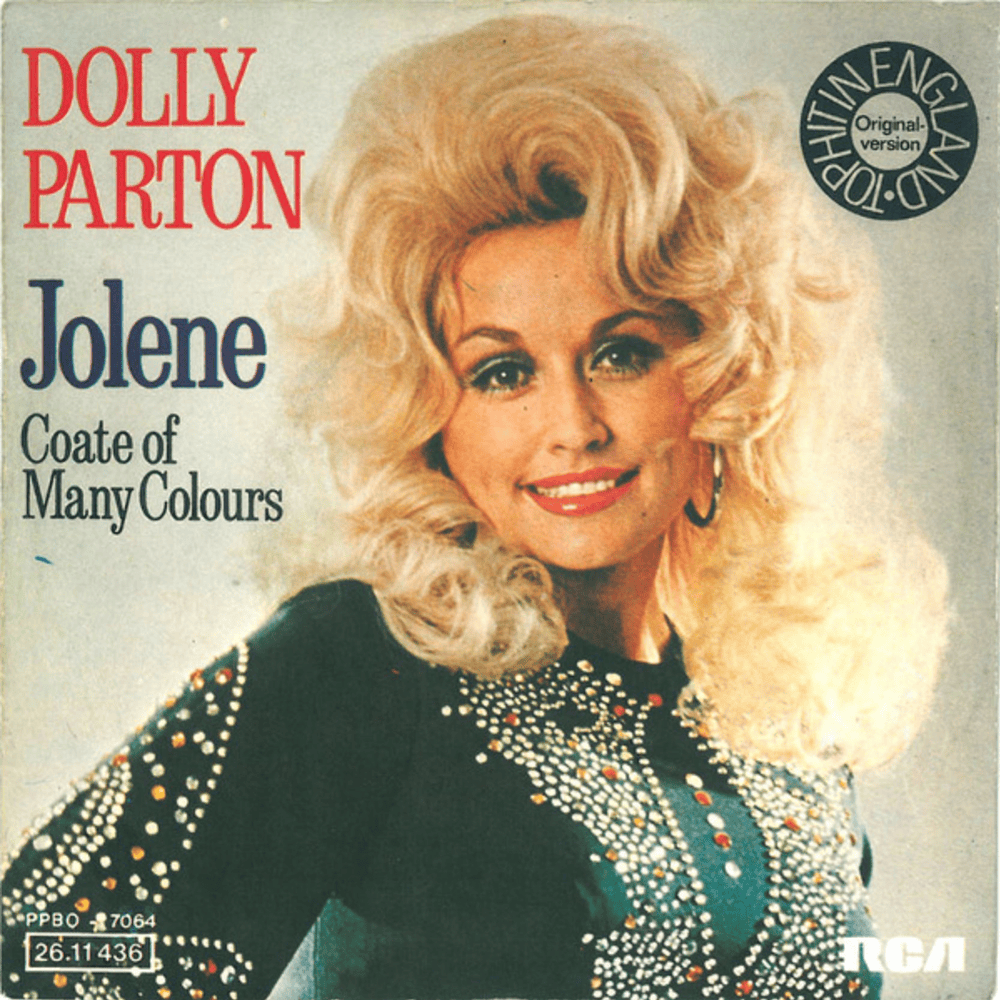
About The Song
“Jolene” is a song written and performed by American country music artist Dolly Parton. It was produced by Bob Ferguson and recorded at RCA Studio B in Nashville, Tennessee, on May 22, 1973. The track was released on October 15, 1973, by RCA Victor as the first single and title track from Parton’s thirteenth solo studio album of the same name. The album itself followed on February 4, 1974. The B-side of the single was “Love, You’re So Beautiful Tonight.”
The song debuted at number 98 on the Billboard Hot Country Songs chart dated November 3, 1973. It climbed steadily and reached number one on the chart dated February 2, 1974, in its fourteenth week. It remained at the top for one week and spent a total of 19 weeks on the Hot Country Songs chart. This marked Parton’s second solo number-one single on the country charts. On the Billboard Hot 100, “Jolene” peaked at number 60. It also reached number 44 on the Billboard Adult Contemporary chart. Additionally, the single topped both the Cash Box Country Singles chart and the all-genre Cash Box Top 100 chart.
Internationally, “Jolene” performed strongly in several markets. It reached number one on the RPM Country Singles chart in Canada. On the RPM Top Singles chart it peaked at number 84, and on the RPM Adult Contemporary chart at number 40. In the United Kingdom, the song was released later and became Parton’s first top-ten hit there, peaking at number 7 on the UK Singles Chart in 1976. Other international peaks included number 99 on Australia’s Kent Music Report, number 6 in New Zealand, number 3 in South Africa, number 19 in Denmark, number 16 in Sweden, and number 8 in Ireland in 1976.
The recording features distinctive guitar work. Nashville session guitarist Chip Young performed the primary thumb-picked riff on a gut-string classical guitar. Wayne Moss contributed the complementary steel-string guitar part that enters on the second refrain. Young adapted the fingerpicking pattern from a similar approach used by Joe South. Additional session musicians on the track and album sessions included Jimmy Colvard, Dave Kirby, and Bobby Thompson on guitar; Pete Drake and Stu Basore on pedal steel guitar; Bobby Dyson on bass; Kenny Malone, Jerry Carrigan, and Larrie Londin on drums; Hargus “Pig” Robbins and David Briggs on piano; Johnny Gimble and Mack Magaha on fiddle; Buck Trent on banjo; and background vocals by The Nashville Edition.
Parton has stated that the name and physical description of the character Jolene were drawn from a young fan, approximately eight to ten years old, who approached her for an autograph after a performance. The girl had red hair, fair skin, and green eyes. Parton repeated the name “Jolene” several times while signing and decided it would make a strong song title. Separately, the narrative of the song was inspired by a red-headed bank teller who worked at a local bank branch that Parton’s husband, Carl Dean, frequented in the early years of their marriage. Parton has recounted that the teller paid particular attention to Dean, leading to a running observation between the couple about the frequency of his bank visits.
Parton has indicated in interviews that she wrote “Jolene” around the same period as “I Will Always Love You,” with some accounts placing the two compositions on or near the same day in 1972 or early 1973, though she later clarified that they may have been written a short time apart and later appeared together on the same cassette. The song was recorded during sessions that also produced other material for the Jolene album. The track runs approximately 2:42 in length and is performed in a country style with a distinctive, repeating guitar figure that drives the arrangement.
“Jolene” received a nomination for Best Country Vocal Performance, Female, at the 17th Annual Grammy Awards in 1975. A live recording of the song later received another nomination in the same category in 1976. In 2014, the original recording was inducted into the Grammy Hall of Fame. The song has also received BMI Country and Pop Million-Air Awards recognizing extensive broadcast performances, including awards for over one million and later over three million performances. Nashville Songwriters Association International presented Parton with Songwriter Achievement Awards related to the composition in 1974 and 1975.
Commercially, the single has achieved significant long-term certification. The Recording Industry Association of America certified “Jolene” 3x Platinum on May 24, 2023, for three million certified units in the United States. The parent album Jolene was certified Gold by the RIAA on the same date for 500,000 units. Additional international certifications include multi-platinum awards in markets such as the United Kingdom, Australia, New Zealand, and Norway, reflecting sustained sales and streaming activity over decades.
The song has been ranked on multiple retrospective lists. Rolling Stone placed it at number 217 on its 2004 list of the 500 Greatest Songs of All Time and at number 63 on the revised 2021 list. In 2024, Rolling Stone ranked “Jolene” number one on its list of the 200 Greatest Country Songs of All Time. Other publications have included it among the top country songs of all time in various rankings. According to Parton, “Jolene” is her most frequently covered composition. Notable covers include versions by Olivia Newton-John, The White Stripes, Pentatonix (featuring Parton, which won a Grammy for Best Country Duo/Group Performance), and others. The original track has continued to appear on charts in subsequent years through reissues, digital sales, and streaming.
The single was reissued in certain international markets in later years, including the Netherlands in 1981 and again in 1985 in connection with compilation releases and video projects. Session details and production credits consistently list Bob Ferguson as producer and RCA Studio B as the recording location for the primary track. The combination of Parton’s writing, the distinctive guitar arrangement by Young and Moss, and the focused single release strategy contributed to its immediate chart success and subsequent catalog performance.
Chart data confirms the song’s dual impact on country and broader pop formats in 1973–1974, followed by delayed but significant success in the UK and other territories. Certification milestones and Hall of Fame induction reflect its enduring commercial and archival recognition within the country music industry. Production notes emphasize the role of Nashville session players in realizing the arrangement, with particular attention given in retrospective accounts to the interlocking guitar parts that form a core element of the recording.
Video
Lyric
Jolene, Jolene, Jolene, Jolene
I’m begging of you please don’t take my man
Jolene, Jolene, Jolene, Jolene
Please don’t take him just because you canYour beauty is beyond compare
With flaming locks of auburn hair
With ivory skin and eyes of emerald green
Your smile is like a breath of spring
Your voice is soft like summer rain
And I cannot compete with you, JoleneHe talks about you in his sleep
There’s nothing I can do to keep
From crying when he calls your name, Jolene
And I can easily understand
How you could easily take my man
But you don’t know what he means to me, JoleneJolene, Jolene, Jolene, Jolene
I’m begging of you please don’t take my man
Jolene, Jolene, Jolene, Jolene
Please don’t take him just because you canYou could have your choice of men
But I could never love again
He’s the only one for me, Jolene
I had to have this talk with you
My happiness depends on you
And whatever you decide to do, JoleneJolene, Jolene, Jolene, Jolene
I’m begging of you please don’t take my man
Jolene, Jolene, Jolene, Jolene
Please don’t take him even though you can
Jolene, Jolene