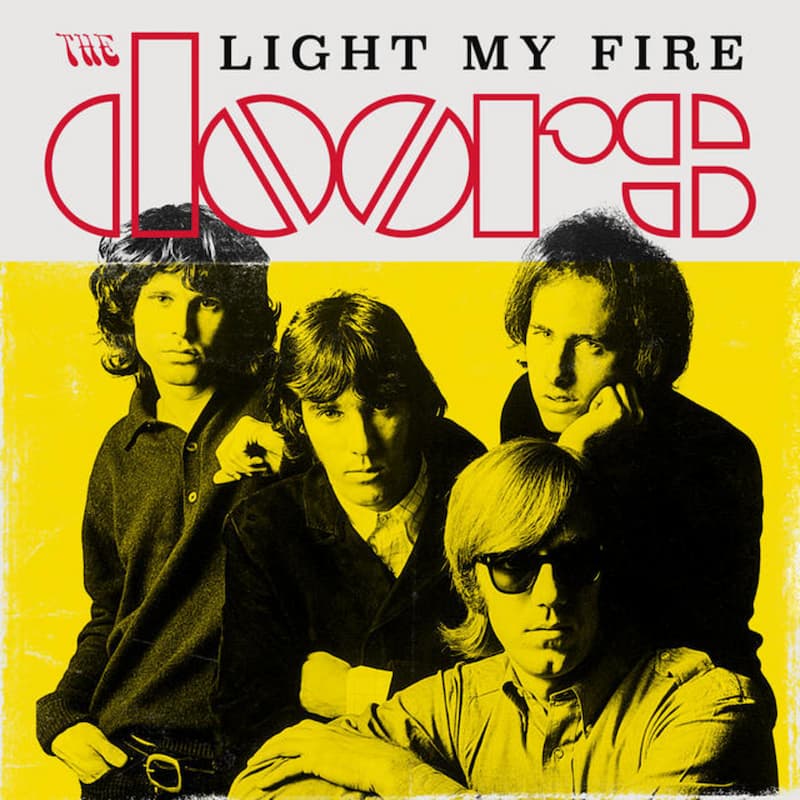
About The Song
“Light My Fire” first appeared as the sixth track on The Doors’ self-titled debut album, released by Elektra Records on January 4, 1967. The album version runs 7:06. An edited single version, timed at 2:52, followed on April 24, 1967, with “The Crystal Ship” as the B-side. The single reached number 1 on the Billboard Hot 100 for three weeks beginning July 29, 1967. It also topped the Cash Box Top 100. The track entered the Hot 100 at number 98 on June 3, 1967, climbed into the top 20 by early July, and held the top spot until The Beatles’ “All You Need Is Love” displaced it. By September 1967 the single had been certified gold by the RIAA for shipments exceeding one million copies. It later received multi-platinum certifications for digital sales and streams. In the United Kingdom the original single peaked at number 49; a 1991 reissue reached number 7. On the Canadian RPM chart it rose to number 2. Additional 1967 peaks included number 16 in Australia (Go-Set), number 7 in New Zealand, and number 27 in the Netherlands.
Songwriting credit is shared by all four band members—Jim Morrison, Robby Krieger, Ray Manzarek, and John Densmore—though the core composition came from guitarist Robby Krieger. In early 1966 Morrison told the other three members that the group needed more original material and asked each of them to write a song. Krieger, then living at his parents’ house in Pacific Palisades, completed a draft that weekend. He later stated that Morrison had advised him to write something universal that would not date quickly. Krieger chose the classical element of fire, citing the Rolling Stones’ 1965 B-side “Play With Fire” as one influence and the chord sequence of The Leaves’ version of “Hey Joe” as another. He deliberately used a large number of chords—approximately fourteen—because most contemporary rock songs relied on three-chord structures.
When Krieger brought the song to rehearsal it retained a folk-rock flavor. Drummer John Densmore proposed a Latin-influenced rhythm that shifted the feel toward jazz and bossa nova. Manzarek supplied the opening organ motif on the Vox Continental, drawing on patterns from Bach’s Two- and Three-Part Inventions; the figure later reappears at the close of the recorded track at the suggestion of producer Paul A. Rothchild. Morrison contributed the second verse, including the lines “The time to hesitate is through / No time to wallow in the mire / Try now we can only lose / And our love become a funeral pyre,” and the closing phrase of the chorus, “Try to set the night on fire.” The band began performing the piece in Los Angeles clubs in the spring of 1966, gradually extending the middle section into long instrumental passages modeled in part on John Coltrane’s modal improvisations over the chords of “My Favorite Things” and “Olé.”
Studio recording took place at Sunset Sound Recorders in Hollywood across three sessions on September 19, 20, and 23, 1966. Rothchild produced; Bruce Botnick engineered. The final album take was assembled from two separate performances spliced together. Session musician Larry Knechtel overdubbed Fender Precision bass to reinforce Manzarek’s left-hand keyboard bass line. The extended solos by Krieger and Manzarek occupy the bulk of the album version. For AM radio play Rothchild prepared the single edit by removing nearly the entire instrumental break, reducing the running time to under three minutes. Elektra founder Jac Holzman and the band approved the edit after initial resistance, reasoning that radio exposure would drive listeners to the full-length album track.
On September 17, 1967, The Doors performed the song live on The Ed Sullivan Show. Producers requested that the line “Girl, we couldn’t get much higher” be altered to remove any possible drug reference. The band rehearsed a revised lyric but Morrison sang the original wording during the broadcast. The group was informed afterward that they would not be invited to return. In October 1968 Buick offered the band $75,000 to adapt the song for a television commercial (“Come on, Buick, light my fire”). Manzarek, Krieger, and Densmore initially agreed while Morrison was unavailable; upon learning of the deal Morrison contacted the company and threatened to smash a Buick on camera if the advertisement aired. The commercial was withdrawn.
A cover version by José Feliciano, released in 1968, reached number 3 on the Billboard Hot 100 and number 1 in Canada. Feliciano’s arrangement earned him the 1969 Grammy Award for Best Contemporary Male Pop Vocal Performance; he also won Best New Artist that year. The Doors’ original recording was inducted into the Grammy Hall of Fame in 1998. Live versions later appeared on the 1983 album Alive, She Cried and subsequent concert releases. The song remained a staple of the band’s set lists through 1970 and was the last piece Morrison performed onstage, at the Warehouse in New Orleans on December 12, 1970.
Chart performance outside the initial 1967 run included a brief re-entry on the Billboard Hot 100 at number 87 in 1968, coinciding with the Feliciano cover. Year-end rankings for 1967 placed the single at number 6 on the Billboard Hot 100 and number 2 on Cash Box. International certifications include gold in Italy, platinum in New Zealand, and silver in the United Kingdom. The track’s structure—verse-chorus form interrupted by an extended dual solo over A-minor and B-minor chords—remains one of the longest instrumental sections on a commercially successful rock single of its era.
Video
Lyric
You know that it would be untrue
You know that I would be a liar
If I was to say to you
Girl, we couldn't get much higher

Come on, baby, light my fire
Come on, baby, light my fire
Try to set the night on fire

The time to hesitate is through
No time to wallow in the mire
Try now we can only lose
And our love become a funeral pyre

Come on, baby, light my fire
Come on, baby, light my fire
Try to set the night on fire, yeah

The time to hesitate is through
No time to wallow in the mire
Try now we can only lose
And our love become a funeral pyre

Come on, baby, light my fire
Come on, baby, light my fire
Try to set the night on fire, yeah

You know that it would be untrue
You know that I would be a liar
If I was to say to you
Girl, we couldn't get much higher

Come on, baby, light my fire
Come on, baby, light my fire
Try to set the night on fire
Try to set the night on fire
Try to set the night on fire
Try to set the night on fire