About The Song
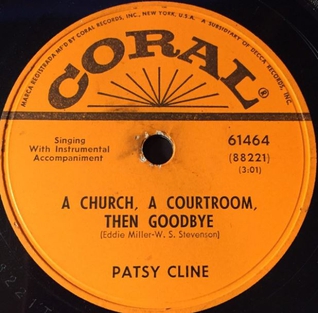
“A Church, a Courtroom, and Then Goodbye” (sometimes stylized as “A Church, A Courtroom And Then Goodbye”) is the debut single by American country singer Patsy Cline. Written by Eddie Miller and W.S. Stevenson, it was recorded on June 1, 1955, at Bradley Film and Recording Studio (also known as Bradley Studios) in Nashville, Tennessee, during Cline’s first official Nashville recording session under her Four Star Records contract. Four Star leased the masters to Decca Records’ Coral subsidiary for distribution. The session marked the beginning of Cline’s professional recording career in Nashville, with Owen Bradley involved as associate producer/arranger (playing piano and directing), alongside Paul Cohen as primary A&R man. Musicians included notable session players like Grady Martin on electric guitar and Bob Moore on bass, establishing continuity in her later work.
The single was released on July 20, 1955, as Coral 78/45 61464, with “Honky Tonk Merry Go Round” (written by Carl Belew, W.S. Stevenson, and Tommy Hill) as the B-side. It did not chart on the Billboard country or pop lists, reflecting limited commercial success typical of Cline’s early Four Star era material before her breakthrough with “Walkin’ After Midnight” in 1957. The track runs approximately 3:05 in the studio version. It later appeared on various posthumous compilations, including collections like Patsy Cline (her 1957 debut album, though not originally on it), Here’s Patsy Cline (1965), and numerous budget anthologies, gospel packages, and reissues such as those from MCA/Decca archives. Live performances exist, including a 1955 Grand Ole Opry appearance shortly after release and TV/radio transcriptions from the era.
Musically, the song is a classic honky-tonk country weeper with traditional instrumentation: fiddle, steel guitar, acoustic rhythm, and Cline’s raw, emotive vocals characteristic of mid-1950s Nashville production. The lyrics narrate a failed marriage—from the joyful church wedding vows, through marital troubles leading to a courtroom divorce, ending in a final goodbye—delivered with poignant heartbreak and narrative storytelling common in the genre. Owen Bradley’s early involvement as arranger helped shape the sound, though Cline’s Four Star contract restricted her to label-provided material, limiting creative control until her Decca shift in the late 1950s. This track represents her pre-stardom phase, rooted in straightforward country before the smoother Nashville Sound of her 1960–1963 hits like “I Fall to Pieces” and “Crazy.”
As Cline’s first commercial release, the song holds historical significance in her discography of over 100 recordings from 1955 to 1963. Though it sold poorly, it introduced her to the Grand Ole Opry (where she debuted around July 1955 performing the track) and laid groundwork for her career trajectory. Expert sources and discographies highlight its role as a “country weeper” that showcased her vocal potential, even amid modest sales. Posthumously, following her death in a March 5, 1963 plane crash, it has been reissued frequently in retrospectives, underscoring her enduring influence as a pioneering female country artist who bridged traditional honky-tonk with crossover appeal. The single’s failure did not deter Bradley, who continued producing her and recognized her talent for future development.
Video
Lyric
The first scene was the church, then the altar
Where we claimed each other with tears of joy we cried
Our friends wished us luck there forever
As we walked to the door as man and wifeBut the first scene was a church, the second was a courtroom
Where we settled things that should have been settled long ago
The third scene was the goodbye, the final goodbye
A church, a courtroom, then goodbyeThe next scene was the courtroom
Where we settled things that should have been settled long ago
We parted there as strangers
With no love left to showBut the first scene was a church, the second was a courtroom
Where we settled things that should have been settled long ago
The third scene was the goodbye, the final goodbye
A church, a courtroom, then goodbye