About The Song
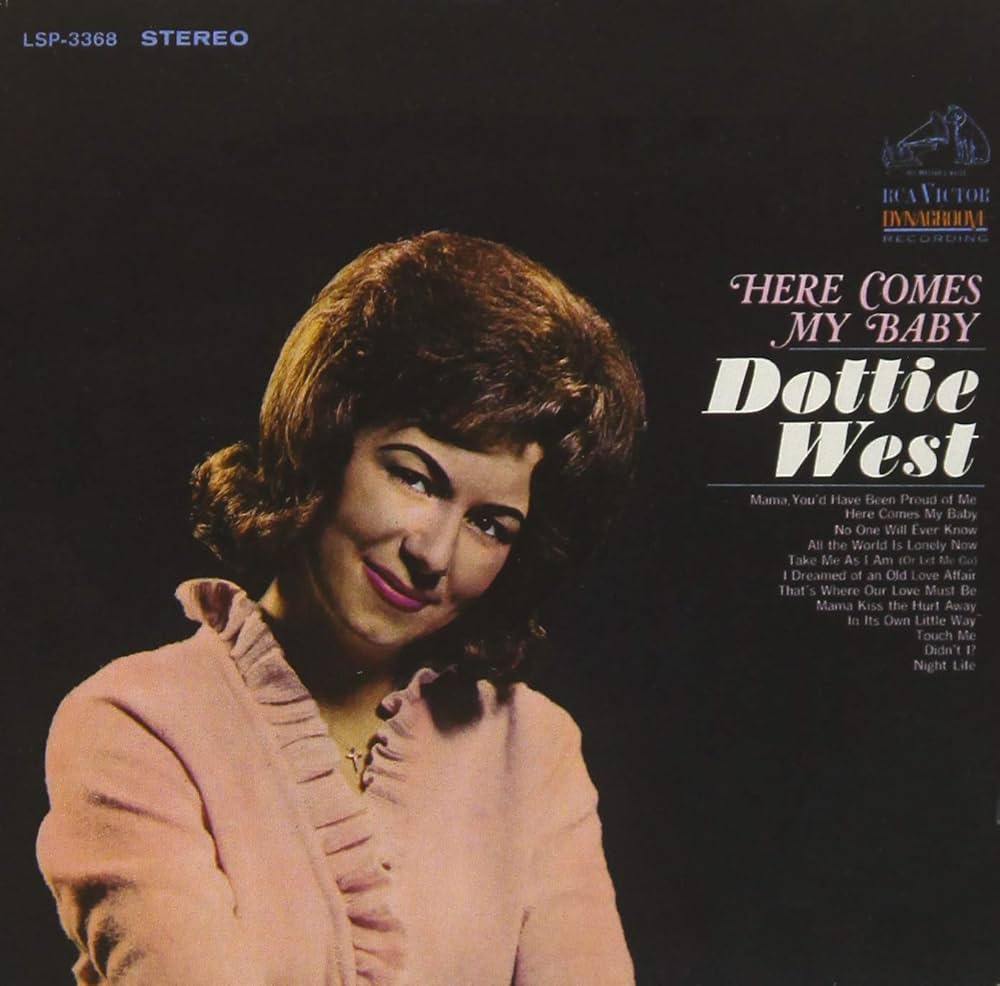
“Here Comes My Baby” is a pivotal song in the career of American country music artist Dottie West, released in June 1964 as the lead single and title track from her debut studio album with RCA Victor Records. Co-written by Dottie West and her then-husband Bill West, the song was crafted in a single day and recorded at RCA Victor Studio in Nashville, Tennessee. Produced by the legendary Chet Atkins, the track epitomized the polished Nashville Sound, featuring a slow-paced tempo, soft piano, delicate strings, and West’s emotive vocal delivery. Clocking in at approximately 2:58, the song’s arrangement was enhanced by contributions from top session musicians, including guitarists Ray Edenton, Grady Martin, Harold Bradley, and Jerry Reed, with Bill West on steel guitar, and the Anita Kerr Singers providing backing harmonies.
In 1964, Dottie West was striving to establish herself in Nashville’s competitive music scene. Born Dorothy Marie Marsh on October 11, 1932, in McMinnville, Tennessee, she had faced early hardships, growing up in poverty and helping her mother run a restaurant. After moving to Cleveland, Ohio, in the 1950s, she performed on the Landmark Jamboree as part of the Kay-Dots duo. By 1963, West had caught the attention of RCA’s Chet Atkins, thanks to Jim Reeves, who recorded her song “Is This Me?” and recommended her to the label. Her initial RCA singles, “Touch Me” and “Let Me Off at the Corner” (No. 29 on the Billboard Hot Country Singles chart), showed promise, while her duet with Reeves, “Love Is No Excuse,” reached the Top 10 in 1964 following Reeves’ death.
“Here Comes My Baby” marked West’s breakthrough as a solo artist. Released in June 1964, it debuted on the Billboard Hot Country Singles chart and peaked at No. 10 in late 1964, spending 12 weeks on the chart. The song’s success was unexpected, as West later recalled in interviews, given her status as a relatively new artist. Its popularity earned her a BMI Songwriter’s Citation of Achievement and, in 1965, the first Grammy Award ever given to a female country artist for Best Female Country Vocal Performance, a historic milestone. The song also led to West’s induction into the Grand Ole Opry on August 8, 1964, cementing her rising star status.
The track’s success prompted the release of the Here Comes My Baby album in June 1965, which reached No. 12 on the Billboard Top Country Albums chart. Recorded between 1963 and 1965, the album featured five tracks co-written by West, including the follow-up single “Didn’t I,” which peaked at No. 32. The song’s narrative, centered on the bittersweet return of a wayward lover, resonated with audiences, and its universal theme inspired nearly 100 covers by artists like Eddy Arnold, Don Gibson, and Dean Martin. Notably, Canadian artist Anita Perras released a version in 1990, which hit No. 9 on the RPM Country Tracks chart. Behind the scenes, Atkins’ production emphasized West’s vocal clarity, while Bill West’s steel guitar added a distinctive country texture. The song remains a cornerstone of West’s legacy, celebrated for its role in breaking gender barriers in country music.
Video
Lyric
Here comes more tears to cry
Here comes more heartaches by
Here comes my baby, back again
Here comes more misery
Here comes old memories
Here comes my baby, back againMy arms are open wide
To let more hurt inside
Here comes my baby, back again
He’s sorry once again
Once more I’ll understand
Here comes my baby, back againMy arms are open wide
To let more hurt inside
Here comes my baby, back again
He’s sorry once again
Once more I’ll understand
Here comes my baby, back again