About The Song
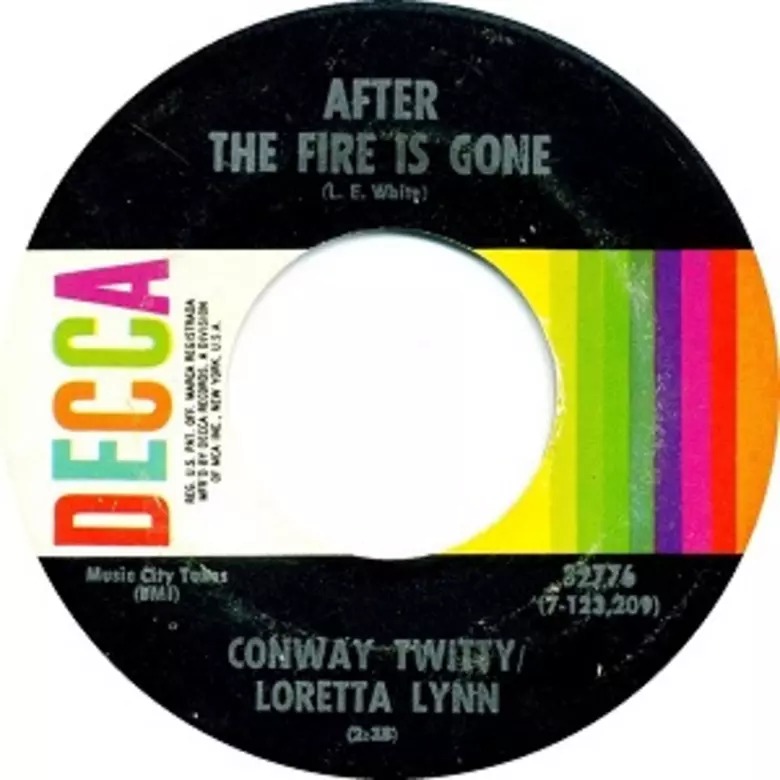
“After the Fire Is Gone” is a country song written by L. E. White and recorded as a duet by American country music artists Conway Twitty and Loretta Lynn. It was released as a single on January 4, 1971, by Decca Records under catalog number 32776. The track served as the only single from the duo’s first collaborative studio album, We Only Make Believe, which was issued on February 1, 1971. Produced by Owen Bradley, the single features the B-side “The One I Can’t Live Without” (also listed in some sources as “One I Can’t Live Without”).
L. E. White (Luther Elmer White Jr.), a songwriter and musician associated with Nashville publishing circles including Twitty Bird Music, composed the song. White had earlier worked as a fiddler with Bill Monroe’s Blue Grass Boys and later contributed material for Twitty’s catalog. Recording sessions for the album took place November 9–11, 1970, at Bradley’s Barn in Mount Juliet, Tennessee. Session personnel included Ray Edenton on acoustic guitar, Herman Wade on electric guitar, John Hughey on steel guitar, Hargus “Pig” Robbins on piano, Bob Moore and Harold Bradley on bass, Tommy Markham on drums, and The Jordanaires on background vocals. Engineer credits include Jim Williamson.
The single entered the Billboard charts in early 1971. It reached number one on the Billboard Hot Country Singles chart for two weeks, dated March 27 and April 3, 1971, and remained on the chart for a total of 14 weeks. This marked the first number-one single for Twitty and Lynn as a duo. On the Billboard Hot 100, the song peaked at number 56. It also reached number 4 on the Canadian RPM Country Tracks chart. The parent album We Only Make Believe peaked at number 3 on the Billboard Top Country Albums chart and number 78 on the Billboard 200. The album was later certified Gold by the RIAA.
At the 14th Annual Grammy Awards in 1972, the recording won the award for Best Country Performance by a Duo or Group with Vocal. The collaboration between Twitty and Lynn originated after the two performed together during an overseas tour; they subsequently auditioned material for producer Owen Bradley, who approved the pairing. This led to a series of joint albums and singles spanning the 1970s and early 1980s. We Only Make Believe was the first of ten studio albums the duo released together.
Subsequent singles from the partnership included additional number-one country hits such as “Lead Me On” (1971), “Louisiana Woman, Mississippi Man” (1973), “As Soon as I Hang Up the Phone” (1974), and “Feelins'” (1975). The pair received Vocal Duo of the Year honors from the Country Music Association for four consecutive years from 1972 to 1975. Catalog reissues have featured the track on various compilations, including Honky Tonk Girl: The Loretta Lynn Collection and other MCA and Universal collections.
Cover versions include a 1974 recording by Willie Nelson and Tracy Nelson that reached number 17 on the Billboard Hot Country Singles chart. Additional covers have been recorded by Tanya Tucker (on her 2010 album My Turn), Allison Moorer and Steve Earle (on the 2010 Loretta Lynn tribute album Coal Miner’s Daughter), Ricky Lynn Gregg (1994), and others including George Jones and Tammy Wynette, Freddy Fender, and Daryle Singletary with Rhonda Vincent. A later version featuring Loretta Lynn with Jeff Bates appeared in 2014.
Chart documentation confirms the original single’s primary success on country formats with limited pop crossover. The recording length is approximately 2:38–2:40 in the original single version. Publishing is associated with Twitty Bird Music and related entities under L. E. White as the sole writer. The duo’s joint discography ultimately included 13 charted singles, with five reaching number one on the Billboard country chart. International pressings of the single appeared in markets including Canada, Singapore, and New Zealand under Decca and MCA labels.
The album We Only Make Believe contains 11 tracks and mixes original material with covers. In addition to the title track and the hit single, it includes versions of “It’s Only Make Believe,” “Pickin’ Wild Mountain Berries,” and other selections. Commercial performance of the album and single established the Twitty-Lynn partnership as a consistent commercial presence on the country charts through the decade. No significant additional U.S. chart peaks beyond the documented positions are recorded for the original 1971 single release.
Later catalog editions under Universal Music Group and related imprints preserve the original masters. Session details align with standard Nashville practices of the early 1970s under Owen Bradley’s production. The song remains part of the documented sequence of Decca and MCA releases that defined the commercial output of both artists during this period of their careers.
Video
Lyric
Love is where you find it
When you find no love at home
And there’s nothin’ cold as ashes
After the fire is goneThe bottle is almost empty
The clock just now struck ten
Darlin’ I had to call you
To our favorite place againWe know it’s wrong for us to meet
But the fire’s gone out at home
And there’s nothin’ cold as ashes
After the fire is goneLove is where you find it
When you find no love at home
And there’s nothin’ cold as ashes
After the fire is goneYour lips are warm and tender
Your arms hold me just right
Sweet words of love you remember
That the one at home forgotEach time we say is the last time
But we keep hangin’ on
And there’s nothin’ cold as ashes
After the fire is goneLove is where you find it
When you find no love at home
And there’s nothin’ cold as ashes
After the fire is gone