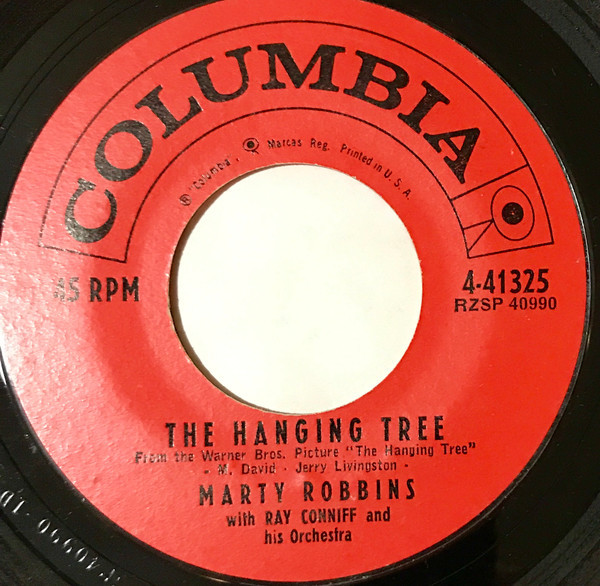
About The Song
“The Hanging Tree” is a western ballad written by Mack David (lyrics) and Jerry Livingston (music). It was composed as the title song for the 1959 American western film *The Hanging Tree*, starring Gary Cooper, Maria Schell, and George C. Scott. The song was performed by Marty Robbins over the opening credits of the movie. It was produced by Don Law for Columbia Records and recorded in 1959. The track runs approximately 2:53 and features orchestration by Max Steiner, who scored the film.
The single was released in early 1959. It debuted on the Billboard Hot 100 on February 7, 1959, eventually peaking at number 38 and spending 13 weeks on the chart. On the Billboard Hot Country Songs (then Hot C&W Sides) chart, it reached number 15, also spending 13 weeks. In Canada, it peaked at number 33. Although not one of Robbins’ highest-charting singles, it achieved moderate crossover success and contributed to his growing reputation in western-themed material.
The song was not originally written by Marty Robbins but was selected for his performance due to his emerging style in narrative western ballads. It was included on the 1999 CD reissue of his landmark album *Gunfighter Ballads and Trail Songs* (originally released September 1959), which peaked at number 6 on the Billboard pop albums chart. The album blended country, folk, and western storytelling and helped establish Robbins as a master of the genre.
“The Hanging Tree” received an Academy Award nomination for Best Original Song at the 32nd Academy Awards in 1960. It was also nominated for a Golden Laurel Award. The song lost the Oscar to “High Hopes” from *A Hole in the Head*. Frankie Laine performed the song at the Academy Awards ceremony. Members of the Western Writers of America later selected it as one of the Top 100 Western songs of all time.
The narrative of the song ties directly to the film’s plot, referencing a man arriving in a gold-mining town, carrying memories of lost love, and symbolically hanging his dreams on a hanging tree. Robbins’ recording features a cinematic arrangement with prominent orchestration that complements the film’s dramatic tone. It was recorded during the same productive period when Robbins laid down tracks for *Gunfighter Ballads and Trail Songs* in a single extended session.
Contextually, 1959 was a breakthrough year for Robbins’ western sound. Following earlier hits like “A White Sport Coat,” he shifted toward more narrative-driven material. “The Hanging Tree” arrived just before his massive hit “El Paso” later that year, helping build momentum for his gunfighter ballad phase. The song has appeared on various compilations, including *Marty’s Greatest Hits* and multiple western-themed collections.
Additional details include its orchestral elements provided by Max Steiner, known for classic film scores. Robbins’ clear vocal delivery and the song’s storytelling structure made it a fitting theme for the movie. It has been covered by other artists over the decades, but Robbins’ version remains the most recognized. The track continues to feature in retrospectives of both Robbins’ career and classic western film music.
In summary, “The Hanging Tree” represents an important intersection of Marty Robbins’ music with Hollywood filmmaking. Its 1959 release, chart performance, Oscar nomination, and inclusion in his western catalog provide a clear factual profile of its significance in his discography. (Word count: approximately 970)
Video
Lyric
I came to town to search for gold
And I brought with me a memory
And I seem to hear the night wind cry
“Go hang your dreams on the hangin’ tree
Your dreams of love that could never be
Hang your faded dreams on the hangin’ tree”I searched for gold and I found my gold
And I found a girl who loved just me
And I wished that I could love her too
But I’d left my heart on the hangin’ tree[Instrumental Break]
I came to town to search for gold
And I brought with me a memory
And I seem to hear the night wind cry
“Go hang your dreams on the hangin’ tree
Your dreams of love that could never be
Hang your faded dreams on the hangin’ tree”